The Artists
Maha Daya
Maha was born in Gaza to parents displaced from Jaffa. Despite holding a BA in Political Science from Al-Azhar University, she pursued her artistic practice through the Summer Art Academy at Darat al-Funun in Amman (2001) and participated in a residency at the Cité International des Arts in Paris (2012).
After October 7, 2023, while living in a fourth-floor apartment in the Al-Rimal neighborhood of Gaza City, Maha witnessed the bombing of many of the city’s landmark buildings, including Palestine Tower. On October 16, 2023, Maha was forced to flee her home in Gaza City with her husband, their three children, and her eighty-six-year-old father. They sought refuge in eastern Khan Younis, but after the building where they were staying was bombed on December 13, they fled west to Al-Mawasi, where they lived in a tent for four months. On April 10, 2024, they left Gaza for Cairo, before Maha relocated to Paris through the PAUSE Fellowship for artists and researchers at risk and the Artists Protection Fund (APF), for the 2025–2026 academic year, undertaking an artistic residency at Columbia Global Paris Center.
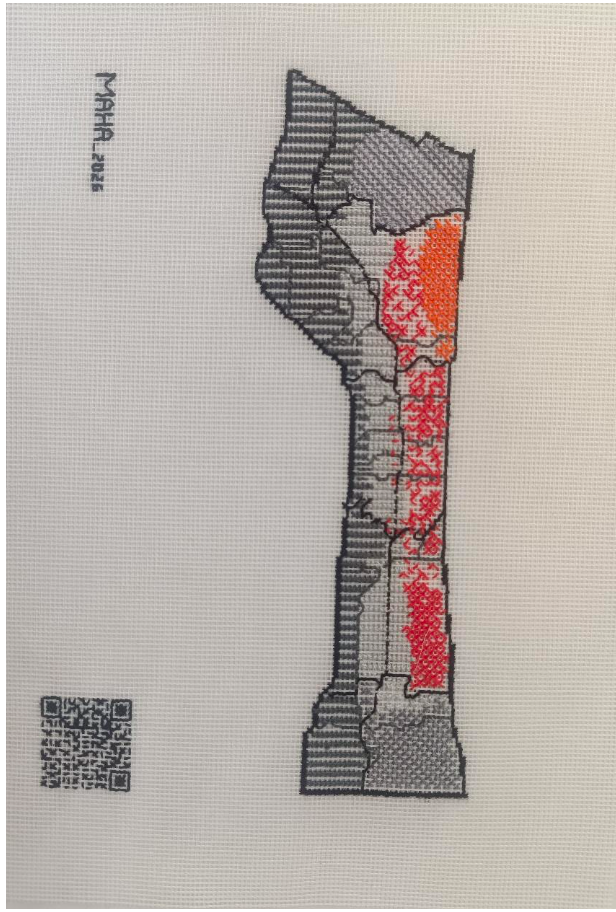
The Yellow Line of Pain, The Green Line of Pain, hand embroidery cross stitch and octagonal stitch on canva, 9.8” x 13.7”, 2026
Zones of Exclusion, hand embroidery cross stitch and octagonal stitch on canva, 9.8” x 13.7”, 2026
Scattered Shards, hand embroidery cross stitch and octagonal stitch on canva, 9.8” x 13.7”, 2026
What Else Do You Want?, hand embroidery cross stitch and octagonal stitch on canva, 12.6” x 15.7” + 13.7” x 15.7”, 2024
Shajaiya, hand embroidery cross stitch and octagonal stitch on canva, 12.6” x 15.7” + 13.7” x 15.7”, 2024
The maps are part of a series titled Via Dolorosa Through Needle and Thread, while the embroidered words are part of the project How Much Can I Say?
Working with Palestinian embroidery (tatreez), textiles, painting, and installation, Maha explores displacement, memory, land, and identity. Through needle and thread, she transforms maps and fragile fabrics into visual testimonies of loss and survival, preserving the geography of Gaza and the traces of lives disrupted by war.
@mahart_76