The Artists
Rana Batrawi
Rana was born in Gaza City to refugee parents who were originally from Isdud, depopulated in 1948. She holds a BA in Fine Arts from Al-Aqsa University. She has developed a distinguished artistic practice while also teaching art at Al-Aqsa University since 2020 and directing the Dar Al-Kalima Training Center in Gaza since 2023. Her work has been featured in numerous exhibitions and residencies across Palestine and internationally.
Rana invested greatly in creating her home and studio in the Tel Al-Hawa neighborhood of Gaza. Before leaving on October 21, 2023, she cleaned and tidied her home, hoping that she would return soon. However, her home was destroyed amid the destruction of many neighborhoods across Gaza. The immense loss and unprecedented violence eventually forced Rana to take her two children and flee to Egypt in February 2024. Six months later, she received the PAUSE Fellowship for artists and researchers at risk, hosted by École Nationale Supérieure d’Art (ENSA) de Bourges, and travelled to France.
Her husband remained displaced in the Gaza Strip, as they hoped that Rana and the children could return home soon. As the genocide continued, leaving Gaza became extremely difficult, and he was evacuated to France only through a special measure by the French government in April 2025, allowing the family to reunite.
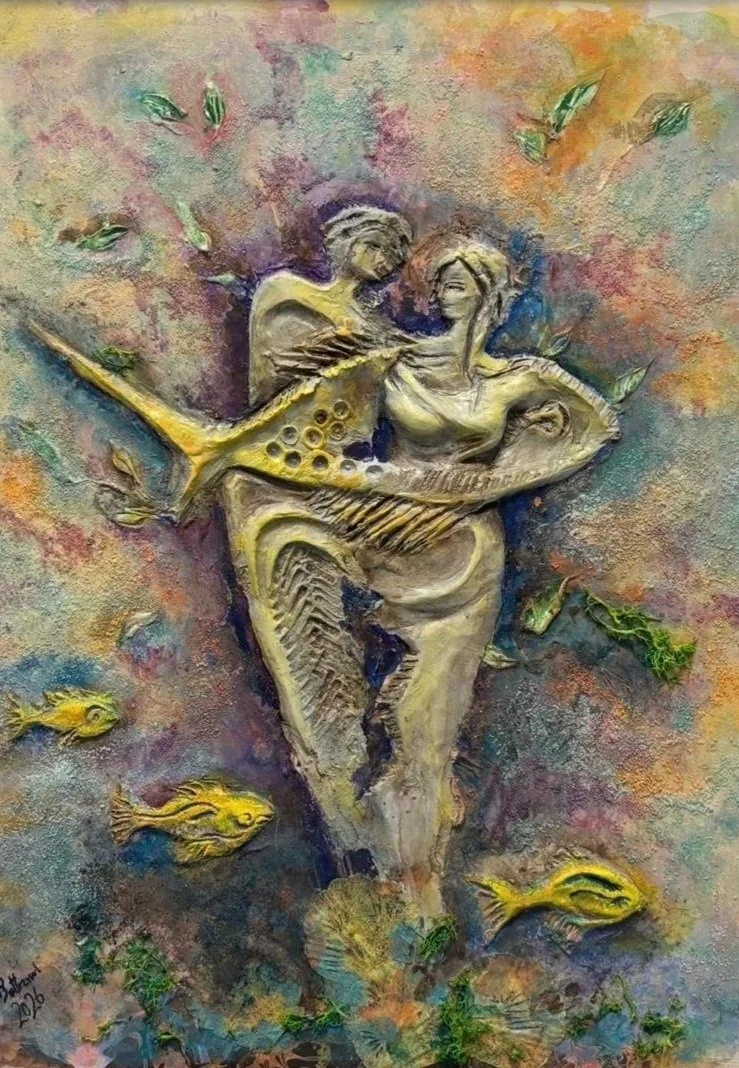
Identity of Tides of the Sea, clay, ash, and acrylic on wood, 16.9” x 13.8”, 2026
Between the Depths, clay, ash, and acrylic on wood, 16.9” x 13.8”, 2026
Maps of Survival, clay and acrylic on wood, 16.9” x 13.8”, 2026
The Sea Remembers Our Names, clay and acrylic on wood, 20.4” x 16.5”, 2026
Rana draws inspiration from Palestine’s cultural heritage, archaeological history, and collective memory. Her work addresses the legacy of Gaza, the narratives of refugee camps, and the shifting realities of displacement and the environment. Through these themes, she seeks to reveal the fragile beauty that endures despite loss and explores how materials themselves—clay, ash, and found remains—can embody memory, resistance, and renewal.
@artworks__rana.battrawi