The Artists
Tahani Skaik
Tahani was born in Gaza to parents originally from Gaza. She studied art at the Teachers’ Training Institute (today, Al-Aqsa University) and worked as an art teacher for sixteen years in Kuwait, where she apprenticed under Jamal Gharbieh. After the Gulf War, in 1990, she returned to Gaza and continued teaching in schools. She then served as Head of the Department of Traditional Handicrafts at the Palestinian Ministry of Culture. Tahani has maintained an active artistic practice and participated in numerous exhibitions in Kuwait, Palestine and internationally. She received the Jerusalem Medal for Culture and Arts for the year 2022.
Tahani was displaced sixteen times and escaped death several times. During her tenth displacement, while sheltering in the Ma’an area of Khan Younis, intense overnight bombardment on October 2, 2024, killed ninety-five people in the neighborhood. Amid the heavy shelling, her husband suffered a heart attack and died. Their shelter was partially damaged, yet they remained there, believing it would not be targeted again. However, on her birthday, December 25, 2024, a missile struck their shelter again, this time killing her niece and her niece’s two children. Tahani and the other survivors were rescued from under the rubble, with severe injuries.
Despite the unbearable pains and loss, Tahani persisted. In February 2025, she returned to her neighborhood in southern Al-Rimal, Gaza City, where she found her home severely damaged and partially destroyed after it had been used as a military base. She cleaned what remained of her home and continues to live there today.
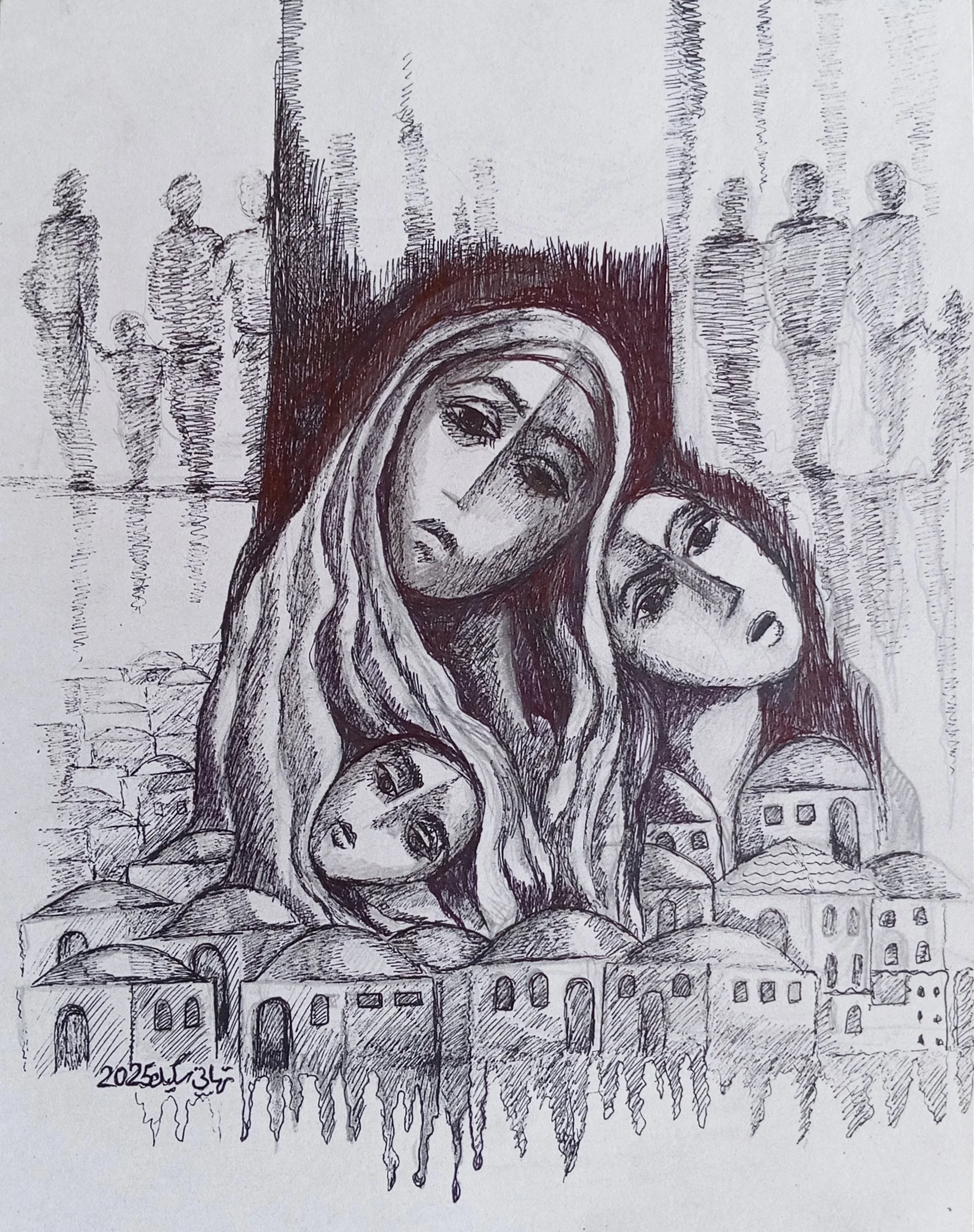
Untitled, pencil and ink on paper, approx. 11” x 16”, 2024, 2025, 2026
Drawing on the social realism and expressionism of Palestinian artists, Tahani brings her own perspective to expressing the daily suffering she experiences alongside nearly two million Palestinians. She explains that she has stopped using colour and now works with shades of grey because everything around her turned grey; the faces of people, the bombed houses and streets, and even the plants.
@skaiktahani